
Oopbuy fees, line by line
The price on a seller page is the first of several numbers. Here is each line that follows, quoted from the operator’s published pages with dates, and the one cost that hides in plain sight.
Two payments, by design
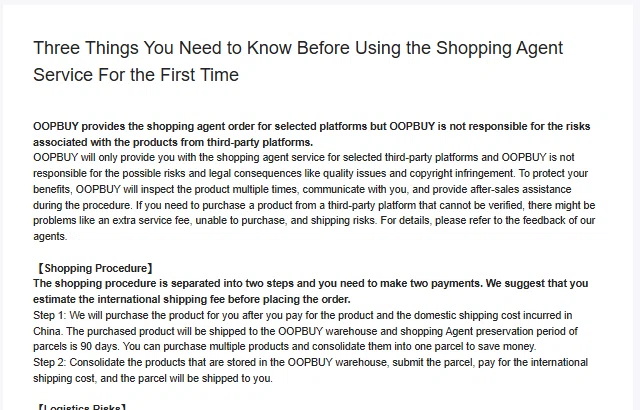
The first-order guide states it plainly: “The shopping procedure is separated into two steps and you need to make two payments.” Payment one covers the item plus its domestic freight to the Xiamen warehouse. Payment two covers international shipping, and it only becomes exact after the parcel is packed and weighed.
The practical consequence: never spend your whole budget on payment one. On a 1 kg US parcel the second payment ran 33.59 to 92.77 USD across routes on 2026-10-10, which is easily half the cost of a modest haul.
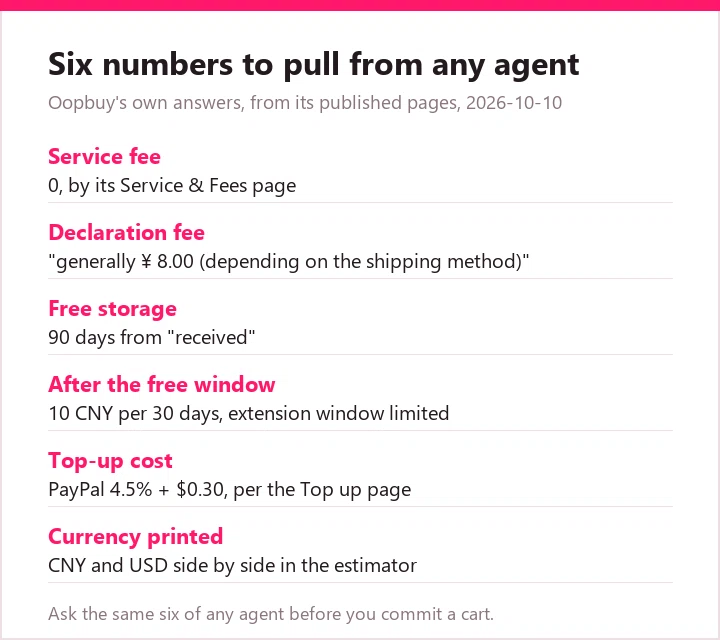
Six numbers, one card
The panel on the right is this site’s working summary of the published fee surface. Two of the six deserve commentary:
- The declaration fee keeps the operator’s own hedge, “generally ¥ 8.00 (depending on the shipping method)”. We quote the hedge because flattening it into “¥8” would claim more certainty than the operator does.
- The 0 service fee is real and published, and it is not the same as free: the margin moves into the conversion rate, measured below.
Optional warehouse services price separately and visibly: the official list is on the right of this page’s fourth stop.
Price the parcel before you buy the item
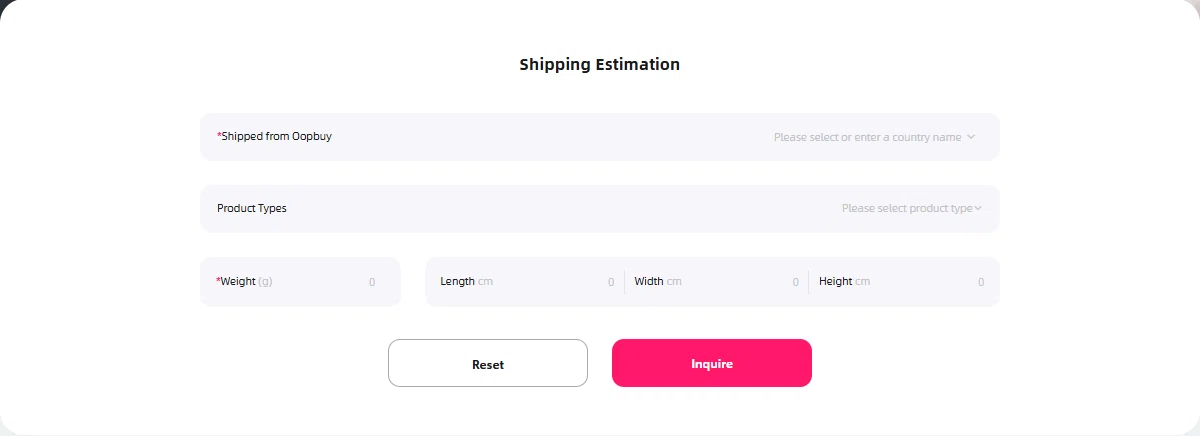
The shipping estimator works without an account: country, product type, weight, optional dimensions. It returns the full route menu with per-route prices, day ranges and limits. Run it with a realistic packed weight before payment one, and your second payment stops being a surprise. For bulky soft goods, add the dimensions; the volumetric rule on the shipping page can out-weigh the scale.
The exchange rate is where the fee went
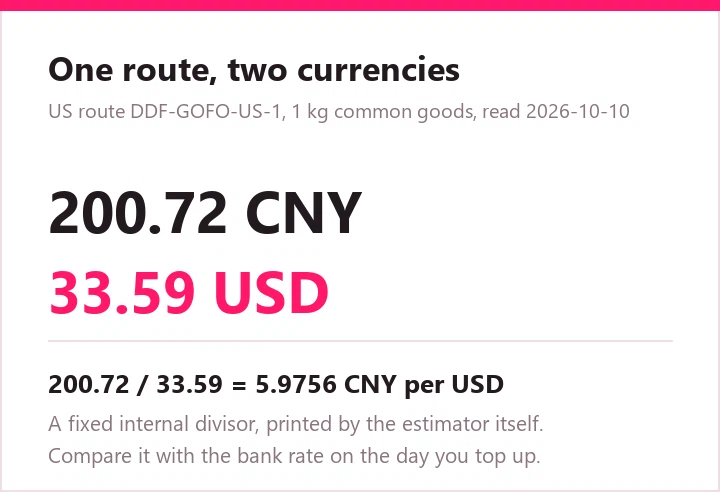
Every route in the estimator prints twice, in CNY and USD, and the two figures sit in a fixed ratio: 200.72 divided by 33.59 is 5.9756 CNY per USD, reproduced across every route in the same response, read 2026-10-10. That divisor is the platform’s internal rate.
The honest move is to compare it against your bank’s rate on the day you top up; the gap, whatever it is that day, is the real service charge. This site publishes the mechanism rather than a percentage, because a percentage measured one day is stale the next. A third-party tracker’s measured all-in markup figure appears on the agent page with its own date.
Optional services, published prices
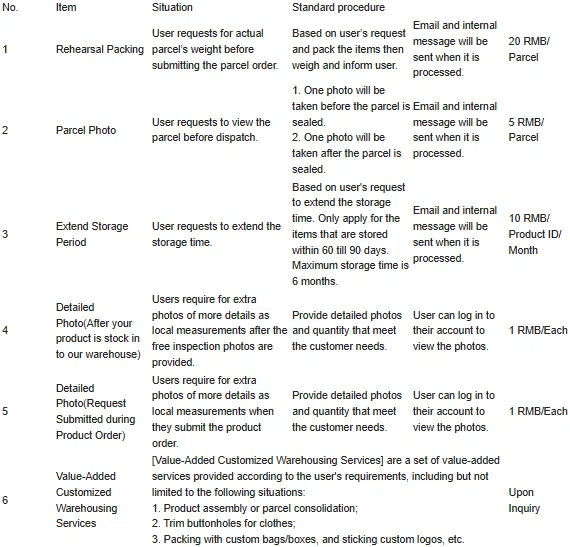
The value-added menu is short and priced in RMB: rehearsal packing 20 per parcel, a sealed-and-unsealed parcel photo pair for 5, detailed photos 1 each, storage extension 10 per product ID per month. Rehearsal packing is the sleeper: for 20 RMB you learn the real packed weight before submitting, which converts the estimator from a guess into a quote.
The price table also carries storage wording that differs from the Storage page; where pages disagree, this site prints the Storage page values on the shipping page and leaves the conflict visible rather than resolving it by guesswork.
Topping up has its own price tag
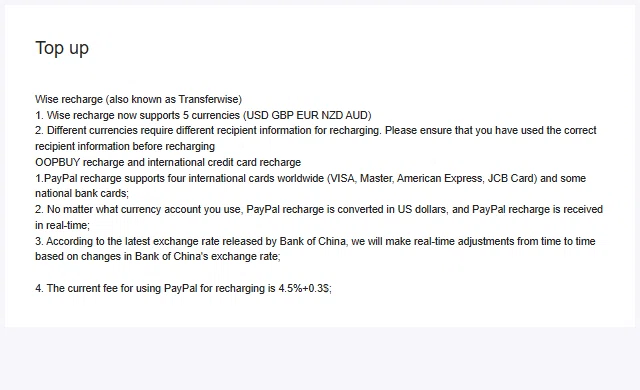
Orders draw from an account balance, and filling that balance costs money too: the Top up page, read 2026-10-10, prices PayPal recharges at 4.5% plus $0.30, with conversion into USD on PayPal’s side. Wise transfers take USD, GBP, EUR, NZD and AUD; international cards and Klarna instalments are listed as well, Klarna in US-facing wording.
On a $200 top-up the PayPal line alone is about $9.30 before any goods move. If your bank offers cheap transfers, the Wise lane usually beats card routes; run your own numbers with the published percentages, both read 2026-10-10.
Last reviewed: 2026-10-11.