
Oopbuy shipping, from shelf to doorstep
The estimator returned 23 US, 15 German and 16 UK routes for the same 1 kg test parcel on 2026-10-10. This page is how to read that menu, declare sanely, and keep the storage clock on your side.
Reading a route card
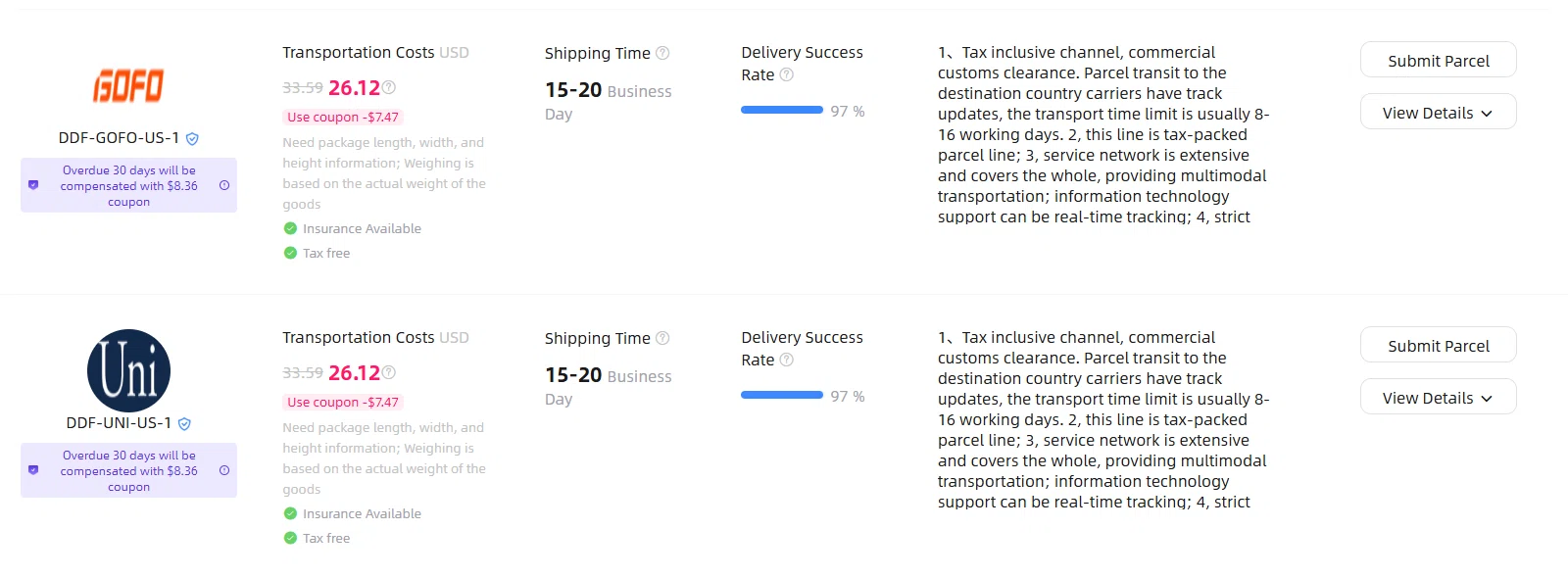
Each route card answers five questions: price in both currencies, day range, delivery success rate, tax handling, and weight-size limits behind the details link. The two cheapest US cards on 2026-10-10 quoted 200.72 CNY (33.59 USD) struck down by an auto-applied coupon, 15-20 business days, a printed 97% success rate and tax-free handling; the fast lane, ZD-UPS-US-HK, quoted 7-12 business days for roughly 2.7 times the price. Day ranges are the operator’s own estimates; the card’s small text even carries an 8-16 working-day transit note for the same line, so plan with the wider bracket.
Weight is a two-headed number
Billing uses the larger of scale weight and volumetric weight, and volumetric is length times width times height in centimetres divided by the route’s coefficient: 8000, 6000 or 5000 depending on the line. A pillow-light puffer jacket in a big box loses to that formula every time.
Routes also carry hard ranges: on the 2026-10-10 US menu, one line took 50 g to 10 kg, another 100 g to 30 kg, with first-weight and continued-weight steps that differ per route. Two levers you control: vacuum bags on soft goods where the route allows them, and rehearsal packing from the fees page to learn the real number before submitting.
Self or fuzzy, the declaration choice
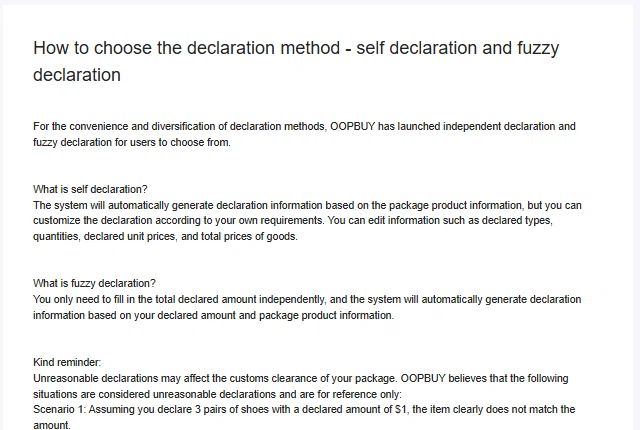
At parcel submission you pick one of two published modes. Self declaration pre-fills item types, quantities and unit prices and lets you edit them; fuzzy declaration takes a single total and generates the rest. The help page’s own examples of unreasonable declarations are instructive: three pairs of shoes at a dollar, a ten-kilogram parcel declared as a ring, a thousand-dollar value on a two-hundred-dollar haul.
Customs risk, duties and fines stay yours in both modes, and the declaration fee keeps its hedged “generally ¥ 8.00” wording. Declare near reality; the mode only changes who types the numbers.
Customs thresholds, as the operator lists them
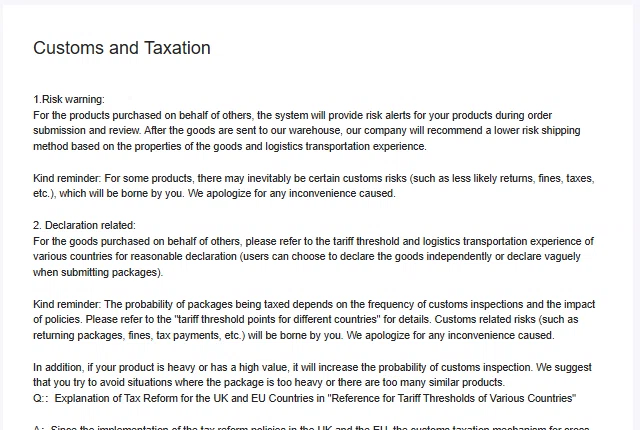
The Customs and Taxation page promises risk alerts during order review and repeats that taxes, fines and returns at the border are the buyer’s burden. Its companion FAQ publishes a reference table of tariff thresholds: 800 USD for the United States, 0 for the UK and EU where VAT applies to every import with a EUR 150 / GBP 135 split, 20 CAD for Canada, and so on, read 2026-10-10.
Treat the table as the operator’s reference, not legal advice; thresholds move with trade policy, and heavy or high-value parcels get flagged for inspection more often by the operator’s own admission.
Consolidation and packing choices
Items from different sellers pool in the warehouse under the 90-day clock and ship as one parcel or in batches, your call per submission. Two published blockers: route-restricted items cannot join a mixed parcel, and anything with a side at or over 90 cm gets flagged for individual packing. Parcels over 10 kg, or stuffed with many identical items, draw commercial-import attention at customs.
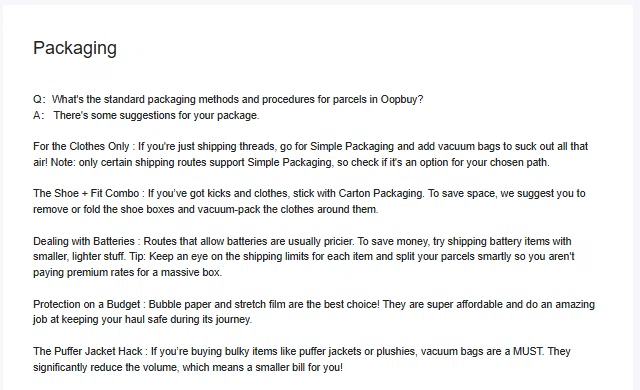
Packing options are concrete: simple packaging with vacuum bags on supported routes, cartons for shoes-plus-clothes mixes, bubble and stretch film for the fragile. The packaging page’s own advice holds up: fold shoe boxes flat and vacuum the clothes around them.
Sending your own parcels in
Oopbuy also takes inbound forwarding: buy somewhere yourself, ship it to the warehouse, let the platform store, consolidate and re-ship it. The flow strip reads Confirm Order, Submit Parcel, Pay Shipping, Wait for delivery, and the warehouse address only appears after login, a deliberate gate the page states outright.
The same page carries the one security line worth repeating: keep your inbound tracking number private, because it is the proof the package belongs to you.

Last reviewed: 2026-10-11.